
El Chancletazo: A Costa Rican Cultural Expression
Learn what el chancletazo means in Costa Rican family humor, how to understand it respectfully, and why travelers may hear the phrase on the Caribbean coast.
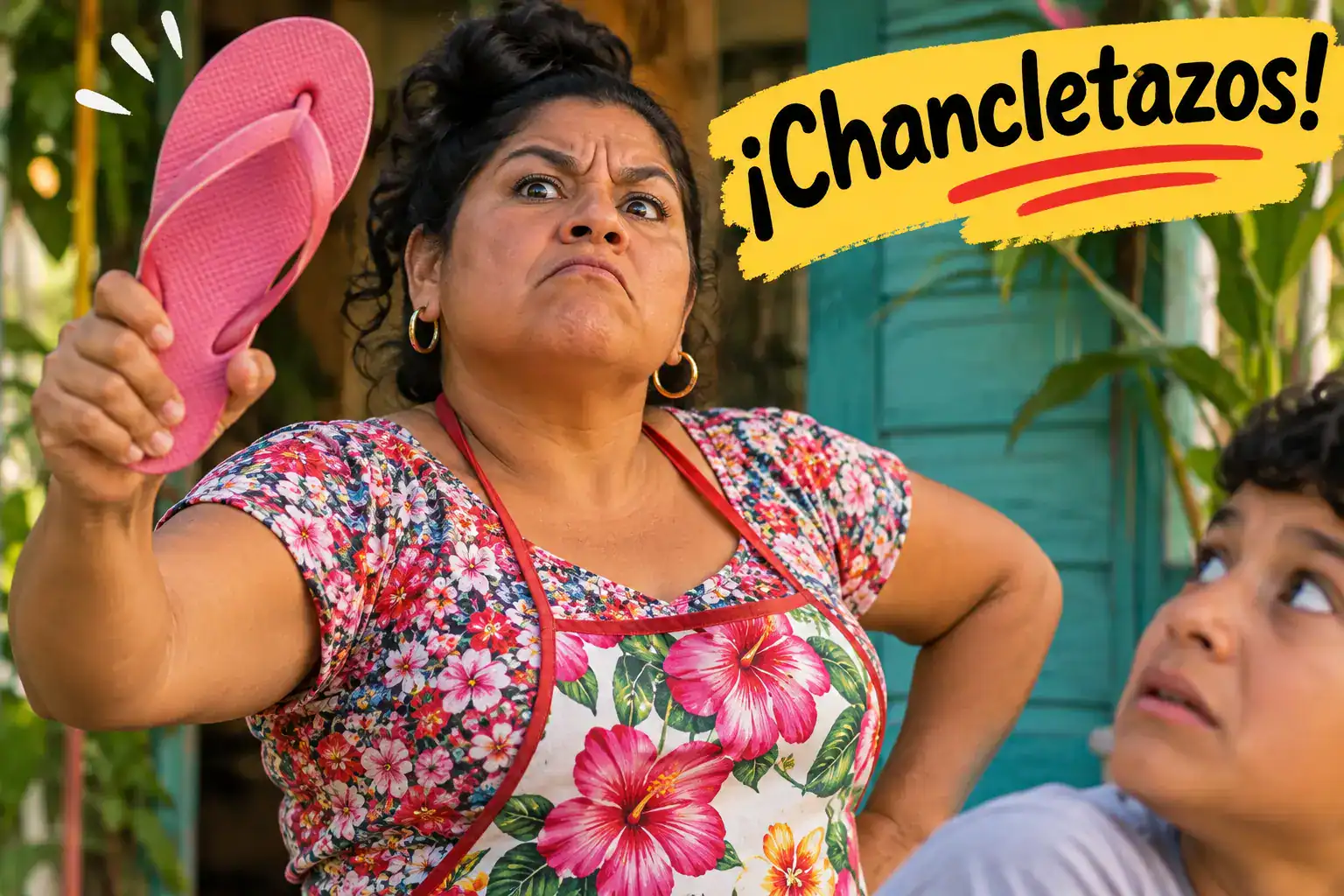
A flip-flop resting beside a front door is ordinary. The phrase el chancletazo, however, can carry an entire family joke. Across Costa Rica and much of Latin America, it refers to the legendary threat of being scolded – or theatrically pursued – with a chancla, the casual sandal often worn at home or to the beach. Visitors to Limón Province may hear it in laughter between relatives, in a playful comment from a shopkeeper, or in Spanish-language social media.
For travelers, understanding the expression offers a small but revealing window into local humor. It is not a tourism term, a regional attraction, or a custom unique to Costa Rica’s Caribbean coast. It is a widely recognizable Latin American cultural reference whose meaning changes with tone, context, and the people using it.
What does el chancletazo mean?
Taken literally, el chancletazo means “the flip-flop hit” or “the sandal strike.” In everyday conversation, it usually evokes a familiar comic image: a mother, grandmother, or another strict caregiver raising a chancla as a warning to a child who has pushed the rules too far.
The humor lies in exaggeration. The chancla is imagined as impossibly accurate, fast, and effective from across a room. Someone might jokingly say, “Careful, or you’ll get the chancletazo,” meaning, “You are about to be told off.” The phrase can also describe the moment when a person receives a sharp verbal correction, even when no sandal is involved.
In English, the closest cultural comparison might be a joke about “waiting until your father gets home,” but that does not fully capture the visual humor or the shared Latin American recognition of the chancla. The object is humble, domestic, and immediately familiar in warm climates where sandals are part of daily life.
A joke that requires context
El chancletazo is often used affectionately among family members and friends, but it should not be treated as proof that physical punishment is harmless or universally accepted. Family discipline is personal, and views on corporal punishment differ across generations, households, and communities. The popular joke is a cultural shorthand, not a description of every Costa Rican family.
That distinction matters for visitors. A traveler may find the phrase funny after hearing it used by locals, but repeating it loudly to strangers, especially parents or children, can feel intrusive. Humor travels best when it follows the lead of the people sharing it.
It also helps to remember that Costa Rican Spanish varies by situation. In relaxed conversation, people may tease one another with colorful phrases. In a formal setting, at a museum, during a business interaction, or when speaking with someone you do not know, straightforward and polite Spanish is the better choice.
The chancla in Caribbean-coast life
On Costa Rica’s Caribbean coast, sandals are practical rather than symbolic. Humid weather, sandy paths, beach towns, and relaxed daily routines make simple footwear common. From Puerto Limón to Cahuita and Puerto Viejo, visitors will see flip-flops and open sandals in many casual settings.
That visual familiarity may make el chancletazo especially easy to understand, but the expression should not be presented as an Afro-Caribbean tradition or assigned to any one community. Limón’s cultural identity is shaped by Indigenous, Afro-descendant, Afro-Caribbean, migrant, and Costa Rican influences, each with its own histories and ways of speaking. A broad Spanish-language meme cannot explain that richness.
The most respectful approach is to enjoy the phrase for what it is: a widely shared piece of colloquial humor that can surface in a region with its own distinct voice, food, music, language, and heritage.
How travelers may hear el chancletazo
Context tells you more than a dictionary translation. If a group laughs after a child playfully ignores an adult, el chancletazo is likely being used as a joking warning. If an older relative recalls childhood, it may be part of a nostalgic story about discipline, household rules, or family character.
You may also encounter it online. Memes, short videos, and comments often portray the chancla as a superhero-like object with perfect aim. These jokes circulate across national borders, so they are not a reliable guide to what is specifically Costa Rican. They are better understood as part of a larger Spanish-speaking internet culture.
For Spanish learners, the phrase offers a useful reminder that literal translations rarely carry the whole meaning. A chancla is a sandal, but the word can summon ideas of home, childhood, authority, comedy, and affectionate exaggeration. Learning to notice those layers is part of moving beyond textbook Spanish.
Useful Spanish around the expression
You do not need to use el chancletazo yourself to understand it. Still, a few related words can help when listening to casual conversation. Chancla means sandal or flip-flop, while regañar means to scold. A regaño is a scolding, and portarse bien means to behave well.
If someone says something that you do not understand, a simple “¿Qué significa?” is always appropriate. In Costa Rica, “¿Qué quiere decir?” is another clear way to ask what a phrase means. Most people will explain colloquial language more accurately than an automatic translation can, particularly when humor is involved.
Avoid assuming that every informal word has the same meaning everywhere. Spanish changes noticeably between countries and even between regions. Costa Rican expressions may be unfamiliar to visitors from Mexico, Spain, Argentina, or the United States, just as a Caribbean-coast turn of phrase may not appear in a standard language course.
A respectful way to engage with local humor
Travel is richer when it includes everyday language, not only place names and menu items. Yet cultural humor works best as an invitation rather than a costume. Listen first, ask questions when welcomed, and let local speakers define the joke’s tone.
This is particularly relevant on the Caribbean coast, where visitors often arrive with simplified ideas about Costa Rica. The region is more than beaches and rainforest: it is home to living communities, multilingual influences, and layered histories that deserve more attention than a viral phrase. Small language discoveries can open meaningful conversations, but they should not replace curiosity about the people and places around you.
If you hear el chancletazo while traveling, smile if the moment calls for it, but read the room. A shared laugh can be a warm point of connection. Respect for the people telling the joke is what gives that connection value.